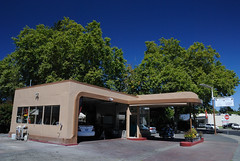
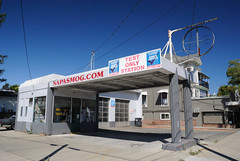
I just moved to Napa in June of 2010, and found myself faced with an overwhelming number of subjects to photograph and research. I set about them without any particular plan until my research on one particular subject (I don't recall what now) led me to the website for the splendid organization
Napa County Landmarks. Every year they compile a list of
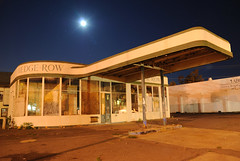
ten threatened historical sites in the county. This 2010 list included two old service stations that had caught my eye. Follow-up information on their website on one of them indicated that it could be demolished any day, so that made me prioritize my efforts. Thus my first blog entry on my new home is on the historic service stations in the city of Napa—both the two threatened ones, and two other lovely old stations that thankfully do not appear to be in danger of disappearing on us anytime soon.
Union Oil Station, ca. 1947
1501 3rd St.
This is the most threatened station of the lot. A Streamline Moderne gem from ca. 1947 that has seen surprisingly little alteration over the years, it fits in quite well with the newly restored Uptown Theatre (1937) just down the street. Napa is surprisingly lacking in historic examples of the sleek and sophisticated designs of the 1920s-1940s, my favorite era of architecture, which makes this little area of town particularly dear to me.
The building has been under the same ownership since 1986, and has been vacant for the the last 14 years. The owner's plan seems to be to neglect it until it either falls apart of its own accord, or it becomes so decrepit that it would be highly impractical to save it, and thus there would be little resistance to the owner tearing it down and putting up something guaranteed to make money in its place.
And indeed the owner has plans to tear it down and build a relatively safe investment in a modest structure of more contemporary design. I've viewed the plans for the proposed building: it would be a cutting-edge structure for 1985. Today the best that could be said for it is that it is familiar and non-threatening, and that it integrates housing with commercial use in the urban core (a very worthy goal).
Nobody has apparently properly researched the old Union Oil Station structure, including, surprisingly, the consultant the owner hired to offer testimony against the building's historic worthiness. That consultant, Mark Hulbert, dates the building to 1948, but offers no evidence upon which he bases this dating. I'm guessing he just checked the Polk City directories available at the library and went no further. 1948 would be a reasonable guess based on such a cursory examination. But the January 1948 Yellow Pages lists the station, so it almost certainly had to have been built by 1947. Not a significant difference to be sure, but just an indication of the carelessness with which the subject is being treated.
On the side of the owner and his consultant, it must be admitted that the building was never a substantial monument. It was not designed for the site by a prominent architect. It is not a unique and grandiose embodiment of the elite art and design of the era in which it was built. The modest size of the structure greatly limits the potential uses the owner can make of the building in any attempt to derive profit from the property.
And that is, after all, what it all boils down to: income from the investment. Because despite the fact that the building is not on a state, national, or international scale an architectural monument on a grand scale, it is quite obviously, in the view of any reasonable Napan, a historically significant architectural example for Napa worthy or preserving for future generations. All one needs to do to realize this is take a look at the building and then walk, or drive, around Napa and look for other equally interesting examples of Streamline Moderne architecture. There are a handful—the Uptown Theatre (of course), another old service station nearby (discussed below), an apartment building around the corner (720 Franklin St.), and the Family Drug building on Old Sonoma Rd. But there are just a handful—nothing at all like the wealth of Victorian architecture that Napa can boast of. The loss of a single building would mark a substantial loss of that era of the city's architectural history.
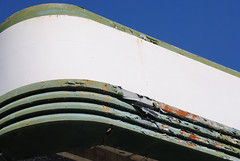
Ironically, the consultant takes the best argument in favor of the preservation of the Moderne service station and turns it on its head. “Obviously, service stations do not make good landmarks. They are a transient use and type.” Sloppy thinking to go along with the sloppy research. Yes, they are of a transient use and type, which is exactly why a well-preserved specimen like the old Union Oil Station is such a rarity and a treasure! And while it is indeed obvious that in the past they have not been treated like landmarks, by no means does it follow that they do not make good ones.
Mr. Hulbert's assessment flies in the face of the trends of the last thirty years in art and architectural history to recognize that everyday art, such as the vernacular architecture of gas stations, coffee shops, and shopping centers, is as much, or more, reflective of the aesthetic of the historical era and influential on the people of that era as the more traditionally recognized monumental works of well-known artists coming out of elite academic programs. The fact that such works were common means that for many years people never considered the issue of their preservation, but that time has long passed, and it's time for Mr. Hulbert to catch up with the rest of the preservation community nationwide or step aside.
The issue at hand is not whether the building is of historic interest architecturally. That is beyond doubt. The question, as it often is in the issue of preservation, is whether it is of great enough interest to radically restrict the manner in which the property owner may try and derive income from his investment in the property. I think all of us struggling to get by can sympathize with the owner's desires, and his frustration that anyone would interfere with his right to do what he wants with something he paid to acquire.
But demolition of the structure is an irretrievably permanent act. Every city in America can point to regrets in preservation battles that were lost—treasures that exist only in photographs and words these days, and lead younger generations to question, “What were they thinking when they tore that down?” Nobody ever has the opposite reaction: “Why did this get preserved? Guess they were wrong on that one.” The people at Napa County Landmarks are working to save the station not because they hate capitalists and hate change and want to make life difficult for small business owners. They are working for the greater good of the community.
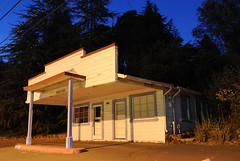
Grippi's Service Station, ca. 1920
1802 Silverado Trail
This is the other station that made the Napa County Landmarks list, a landmark indeed given its prominent location along the Silverado Trail. It says on the building itself that it has been there since 1920, and I have no basis upon which to dispute the word of the edifice. In contrast to the other service stations in this survey, it is not of a fashionable design of the era in which it was built, but the humble structure is instead reflective of its location away from the city center—likely a rural neighborhood at the time it was built.
Mobil Service, ca. 1939-1942
1538 3rd St.
Now operating as Rico's Auto Detailing. I'm not positive that this art deco building was originally opened as Mobil station, but that is what it was in the first Polk city directory that lists the business name (rather than just the business type and owner), 1950.
Richfield Service Station, ca. 1935-1937
1509 Main St.
This is my personal favorite of the four service station buildings, in part because the structure that held the original signage is still extant. Now operating as Napa Smog Test Only, this is where I went for my last smog check in an effort to do my part to support the preservation of the building.